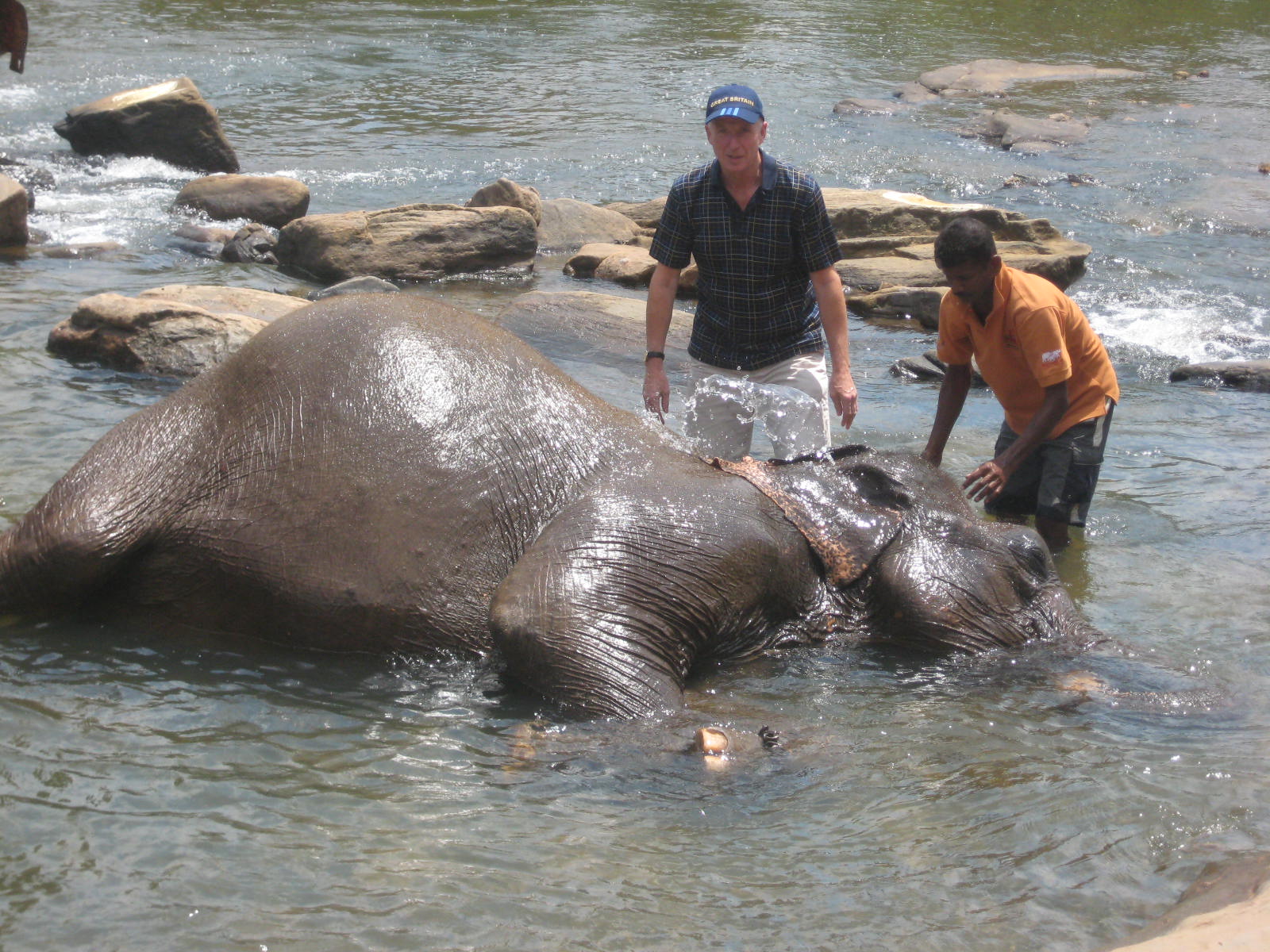
Pinnawala elephant orphanage is about halfway between Colombo and Kandy in the hills of central Sri Lanka. It was originally set up to look after elephants found wandering or orphaned and who were either at risk or who were posing a risk to villagers. They are captive but have a lot of space and freedom. There are upwards of 80 elephants at Pinnawala, probably the largest herd anywhere. Groups are taken to the river each day to cool down, wash, drink and mess about. The one above and below is pregnant and just wanted to rest. I tried to listen to the baby inside but either mum's skin was too thick or my hearing is fading because I didn't hear a sound or feel a kick.
The small group willingly leave the water when asked. The stick is for 'guidance'!
The group walks in an orderly manner from the river, up through a street of shops and across a main road. Quite a shock for the uninitiated tourist.
The next group down to the river was very big, we counted 48, with the largest males bringing up the rear. The group has a lot of babies in it and they like to run so the chap front left of the photo has a loud hailer to warn people to get out of the way. I am standing pretty much in front of them.
Here's one of the big guys bringing a snack with him.
We had a different kind of snack!
Monday, August 27, 2012
Monday, July 30, 2012
Old Cracow
We went for a walk around Kazimierz, where the Jewish culture thrived before WWII. That culture is coming to the fore once again as part of a more multicultural area with cafes, bars, shops and a flea market included. Important synagogues such as the Kupa and the Isaak, sit close to some of old Cracow's 150 catholic churches, such as the huge Corpus Christi (below). The wooden pulpit is fishing boat shaped, complete with oars, nets and mermaids
A sadly derelict children's playground, unused except for the cat. Can you spot it?
More baffling than the two gentlemen outside St Mary's Basilica. How does she do it?
Plenty of good quality street music about, but happily for us, the streets are not crowded.
Refreshment...
Sunday, July 29, 2012
Birkenau
Very few buildings remain on the vast Birkenau site. The Nazis hastily destroyed the gas chambers and crematoria as the end of the war approached.
Extremely hot in summer, well below freezing in winter, with virtually no food, a few seconds a day to go to the 'toilet' (the holes in the centre of the block) if you were lucky, no washing or sanitation facilities and crammed three to a bunk, conditions would have been horrific.
The good news was that after our visit to Auschwitz-Birkenau, we drove through the beautiful Polish country side to Wadowice, the birthplace of Pope John Paul II. his former house is now a museum and is next to the church where he was christened. Heading back towards Cracow we drove into the hills to the fabulous monastery at Kalwaria Zebrzydowska.
When the place gets busy they use outdoor confessionals. Pictured are just a few of them!
Extremely hot in summer, well below freezing in winter, with virtually no food, a few seconds a day to go to the 'toilet' (the holes in the centre of the block) if you were lucky, no washing or sanitation facilities and crammed three to a bunk, conditions would have been horrific.
The good news was that after our visit to Auschwitz-Birkenau, we drove through the beautiful Polish country side to Wadowice, the birthplace of Pope John Paul II. his former house is now a museum and is next to the church where he was christened. Heading back towards Cracow we drove into the hills to the fabulous monastery at Kalwaria Zebrzydowska.
When the place gets busy they use outdoor confessionals. Pictured are just a few of them!
Auschwitz (the Nazi name; Oswiecim in Polish)
Many words have been said and written already so I will add only a few more. Below is what the Nazis called the kitchen. They did not want prisoners to last very long, the aim was to work them to death so the 'food' was nothing more than occasional watery 'soup'.
I was certainly upset at some of the things that we saw at the 'camp'. More often I was disgusted at the lengths to which the Nazis would go to make the prisoners suffer. for example, below are two posts. Victims would be pinioned by their arms and made to hang for hours just above the ground. Shoulders would become dislocated and when finally released from this torture, the victims would be expected to work; either that or be shot. You could be tortured for nothing more than looking at one of the guards. About 1.5 million people suffered here, mostly Jews, Poles, Russian POWs, gay people, the disabled. Some prisoners on outside work managed to smuggle messages to Polish resistance fighters. One set of messages included the names of the most brutal of the SS in the camp. Their names were then published in British and US newspapers, causing the cowards to be upset and providing the inmates with small but morale boosting satisfaction.
A relatively minor number of the SS were brought to justice after the war. The gallows below were used to hang prisoners, usually in front of others to add to their terror. A small satisfaction for some was that after WWII the camp commandant was hanged here, just outside his residence. Having been inside the buildings and seen the rows of photographs of prisoners, the collections of hair, spectacles, toothbrushes, suitcases, false limbs, babies' shoes for example, I understand why the people at the Simon Wiesenthal Centre continue to hunt down the perpetrators of the appalling crimes of the Nazis and I wish them well in their efforts.
Last stop on the tour is to enter a gas chamber.
I was certainly upset at some of the things that we saw at the 'camp'. More often I was disgusted at the lengths to which the Nazis would go to make the prisoners suffer. for example, below are two posts. Victims would be pinioned by their arms and made to hang for hours just above the ground. Shoulders would become dislocated and when finally released from this torture, the victims would be expected to work; either that or be shot. You could be tortured for nothing more than looking at one of the guards. About 1.5 million people suffered here, mostly Jews, Poles, Russian POWs, gay people, the disabled. Some prisoners on outside work managed to smuggle messages to Polish resistance fighters. One set of messages included the names of the most brutal of the SS in the camp. Their names were then published in British and US newspapers, causing the cowards to be upset and providing the inmates with small but morale boosting satisfaction.
A relatively minor number of the SS were brought to justice after the war. The gallows below were used to hang prisoners, usually in front of others to add to their terror. A small satisfaction for some was that after WWII the camp commandant was hanged here, just outside his residence. Having been inside the buildings and seen the rows of photographs of prisoners, the collections of hair, spectacles, toothbrushes, suitcases, false limbs, babies' shoes for example, I understand why the people at the Simon Wiesenthal Centre continue to hunt down the perpetrators of the appalling crimes of the Nazis and I wish them well in their efforts.
Last stop on the tour is to enter a gas chamber.
Cracow, beautiful, inspiring and relaxing
Cracow, the former capital of Poland is a marvellous place to spend a few days. Below you have St Mary's Basilica in Rynek Glowny, europe's largest medieval market square. Every hour (24hrs a day) a bugler appears near the top of the tower and plays a warning to the four points of the compass. He then waves to the crowd who then wave back. Not sure what the crowd was like at 3:00a.m. though.
The weather was great, as you can see. A bit warm for the horses perhaps but they are all well cared for and in beautiful condition.
This is Wawel Cathedral, a short walk form Rynek Glowny. As in all the churches we visited in Cracow, the inside was awe inspiringly beautiful, including the ornate sarcophagi of Polish monarchs and national heroes. Our admiration for the Polish people grows as we hear how they finally gained independence in 1918 after a series of invasions and rule by Swedish, Prussian, Austrian empires. Then followed the dread of the Nazis and 45 years of Soviet repression.
I would be very grateful if someone would tell me how this is done!
Cracow is very relaxing, especially with a glass of Wyziec. Not bad in the back of a horse drawn carriage either!
The weather was great, as you can see. A bit warm for the horses perhaps but they are all well cared for and in beautiful condition.
This is Wawel Cathedral, a short walk form Rynek Glowny. As in all the churches we visited in Cracow, the inside was awe inspiringly beautiful, including the ornate sarcophagi of Polish monarchs and national heroes. Our admiration for the Polish people grows as we hear how they finally gained independence in 1918 after a series of invasions and rule by Swedish, Prussian, Austrian empires. Then followed the dread of the Nazis and 45 years of Soviet repression.
I would be very grateful if someone would tell me how this is done!
Cracow is very relaxing, especially with a glass of Wyziec. Not bad in the back of a horse drawn carriage either!
Saturday, May 19, 2012
Highgate Cemetery, London
A great place for a walk. We went on a sunny
afternoon but I guess a windy Autumn or a spooky night would be just as
uplifting.
£3 to enter or £7 if you want a guided tour. Some
say it is pricey but there’s a big acreage to maintain!
Don’t the photos just make you want to visit?

Famous Residents:
Although its most famous occupant in
the East Cemetery is probably Karl Marx there are many other prominent figures,
Victorian and otherwise, buried at Highgate Cemetery. On a mainly literary and
artistic theme, residents include:
Douglas Adams, (E) author of The
Hitchhiker's Guide to the Galaxy and other novels. Next to him is Eddie Rosen,
son of Michael.
Beryl
Bainbridge, (W) novelist
Farzad Bazoft,(E) journalist, executed by
Saddam Hussein's regime
Jeremy Beadle, (E) TV
presenter, writer and producer, "curator of oddities"
Robert William Buss, (W) artist and illustrator
Patrick Caulfield, (E) painter and printmaker
known for his pop art canvasses
John Dickens and Elizabeth Dickens, (W) parents of
Charles and models for Micawber and Mrs Nickleby
Catherine and Dora Dickens, (W) wife and daughter of Charles
George Eliot (Mary Ann Cross), (E)
novelist
William Alfred Foyle, (E) founder of Foyles the bookshop
Stella Gibbons, (W) novelist
Alexander Litvinenko, (W) Russian dissident turned
critic, murdered by poisoning in London
Malcolm McClaren, (E) performer, impresario,
manager of The Sex Pistols, 'godfather of punk'
Ralph Miliband, (E) left wing political
theorist, father of David Miliband and Ed Miliband
Henry Moore, (1831–95), (E) marine painter
Sir Ralph Richardson, (E) (1902–83), actor
Christina Rossetti, (W) poet
Frances Polidori Rossetti, (W) mother of Dante
Gabriel, Christina and William Michael Rossetti
William Michael Rossetti, (W) co-founder of the
Pre-Raphaelite Brotherhood
Feliks Topolski, (E) Polish-born British
expressionist painter
Patrick Wymark, (W) actor
Garway Hill, Herefordshire
I won’t reveal too much about Herefordshire
because it is a largely rural county that in many ways modern life has passed
by and I hope it stays that way, beautiful, lush and green.
We walked for a couple of hours from our
hotel, the Bell at Skenfrith, through fields and farms to get to the summit of
Garway Hill. Incidentally, the Bell at Skenfrith has great rooms but I would not
recommend the place to anybody. The dining room service was poor and the barman
offhand. The tone was set when the five of us arrived and instead of saying ‘Welcome
to the Bell, I hope that you have an enjoyable stay’ the host said ‘name
please.’
You would be better off at the Garway Moon
Inn which we visited on the way down. It has good food, real ale and a friendly
welcome.
Garway is a village in southwest
Herefordshire, lying approximately equidistant from Hereford, Ross-on-Wye and
Monmouth. Above the village stands Garway Hill, a prominent local landmark
rising to over 1200 feet.
From
the top of the hill there is a view of seven counties in a 360-degree panorama.
White mountain horses graze there most of the year and raise
their foals amongst the bracken. Sheep roam freely. A pond near the summit
provides a water supply for the animals which lasts all the year round, despite
there being no visible source to keep it topped up. The pond is also home to a
protected species of newt.
Here’s us at the summit, is Pete the first
Australian up there? Perhaps not.
Subscribe to:
Posts (Atom)


