
We sample some of the delights in a delightful sweetshop on the main street and then, further along, indulge in the pies at the bakery. Ned Kelly found himself on trial and subsequently imprisoned here.

It must have been very rowdy in the gold rush days, wonderfully peaceful now though.

We take the road to Chiltern and on to Rutherglen.

 Even better views if you decide to go hang gliding. No flyers out when we were there, this is the take-off ramp.
 You are not supposed to feed the wildlife but this chap was rather persistent and kindly cleaned the picnic table for us.


 The other chalet near the top of Mt Buffalois not open for business these days, it was quite spooky wandering around, reminded me of the Overlook Hotel - even though I know many scenes were filmed in Borehamwood, Herts!

 To describe the streets as crowded would be something of an understatement.


 Amongst the pleasures at the top is the fact that the elevation and the tree cover mean that it is lovely and cool for walking. The other pleasure is that it is quiet - during our two hour plus walk, we saw only two people. The paths are not particulalry well marked but you would have to be a pretty useless navigator to get lost. There is little wildlife to be seen, apart from a few birds and beutiful butterflies. Perhaps we were not looking in the right places or maybe it was siesta time. What's the Italian for siesta?
 We did see sheep grazing perilously close to the edges of vast vertical drops and a mountain shepherdess, with Vesuvio in the background.
 The main piazza is dominated by the wonderful Duomo, which, like the other Italian places of worship that we have visited, is beautifully decorated and preserved. The town is very busy but the atmosphere is at the same time relaxed and friendly. The gelateria does a good trade!
 The place is crammed with souvenir shops but there are many narrow lanes and alleys up and down steps where you can enjoy looking at the colourfully painted buildings, courtyards and gardens. People on the beach are squashed together like sardines, I cannot see how that can be at all enjoyable!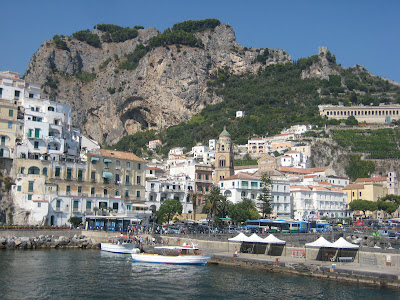
 Napoli is unlike Italy's other great cities; it is sprawling, dirty and smelly in places but fascinating nonmetheless. there are scores of narrow streets, barely wide enough for two people to walk walk abreast at times and yet cars and the ubiquious scooters hurtle along amidst the washing lines (mind you don't get dripped on!) and debris.
 Not all scooters are roadworthy.


