Monday, January 4, 2016

Scotland 31 December 2015 - 4 January 2016

We flew from Luton to Inverness via Easyjet. 1hr 10 mins - my kind of flight!

Loch Ness on 31 December - cold and black. Cold and black all year round I think! The monster was not to be seen, must have gone away for New Year.


Eilean Donan Castle, about 75 miles from Inverness via Loch Ness and Drumnadrochit.
It is one of the most iconic images of Scotland, situated on an island at the point where three great sea lochs meet, and surrounded by some majestic scenery. The first fortified castle was built in the mid 13th century and stood guard over the lands of Kintail. Since then, at least four different versions of the castle have been built and re-built as the feudal history of Scotland unfolded through the centuries. Partially destroyed in a Jacobite uprising in 1719, Eilean Donan lay in ruins for the best part of 200 years until Lieutenant Colonel John MacRae-Gilstrap bought the island in 1911 and proceeded to restore the castle to its former glory. After 20 years of toil and labour the castle was re-opened in 1932.


Plockton in the beautiful bay of Loch Carron.


Plockton faces east, away from the prevailing winds, which together with the North Atlantic Drift, gives it a mild climate allowing plants such as the cordyline to prosper. We also saw hydrangeas and roses in flower. One of the locals said that there are never any frosts but that it rains a lot.
Most of the houses date from the 19th and 20th centuries. It was a planned community based on fishing in an attempt to stem the tide of emigration from the Highlands.

It was a 90 mile drive from Inverness for us, but well worth it. Plockton has a station and you can get there by train in roughly 24hrs from Euston via Inverness! 

 One of the best picnic spots ever!


Glen Affric, 3 January 2016.
Glen Affric is a beautiful glen, stretching for some 30 miles from Kintail in the west to within a couple of miles of Cannich in Strathglass. The burns tumbling down the mountains on the north side of Glen Shiel and from Beinn Fhada culminate in two major streams – Allt a Chòmhlain and Allt Cam-bàn. Together they combine to create the River Affric that flows through two major lochs to Fasnakyle in Strathglass where it meets with the Abhainn Deabhag to form the River Glass.
There is lots of wildlife in the glen but on a cold and grey day we only managed to see two does and three stags.


Monday, December 21, 2015

Kilimanjaro Training Weekend II. Borrowdale

19 & 20 December 2015

This is how Derwent Water presented itself on my arrival in Borrowdale.


The Glaramara Hotel - a good place to stay, boasting excellent food and hospitable staff.


I kid you not, this photo was taken in 'broad' daylight.


Saturday morning and it's looking good to climb Scafell Pike. Unfortunately the wind was gusting up to 50mph and so we had to limit ourselves to the area around High Scawdell.


It rained all night on Saturday but Sunday morning was dry. However, the wind was still persistently strong so we climbed above the village of Braithwaite to Barrow and Stile End.


Return to Oman


We stayed at the Grand Hyatt once again and thoroughly enjoyed it - sun, sea and sand, great food and friendly, helpful staff. Below is the view from our room. We did not use the pool but chose to swim in the sea, which was at a cooler temperature.


We drove to Nizwa, which is just over 100 miles from Muscat, and visited the souk. Here are some of the spices - lovely aromas. We bought some frankincense and an Omani coffee pot.


Nizwa was once the capital of Oman and its fort was built in the C17th. The enormous tower took 30 years to complete. The walls of the fort are thick enough to withstand the effects of incoming cannon fire. We had superb views of Ziwa town and the surrounding valley from the top of the tower.


Beyond Nizwa is the striking Jabrin Castle. It was built as a home in 1670. Its builder, the Imam Bil'arub Bin Sultan was killed in the palace in 1692 following a siege by his brother. Jabrin has been beautifully restored and its painted ceiling are particularly impressive.


Not far from Jabrin Castle is the town of Bahla, which was the capital of Oman before Nizwa. The town has a 13km wall around it, reputedly built around 600 years ago. There is evidence of a fort being built in Bahla in 1000BC. The current incarnation is massive and preserved as a World Heritage Site.


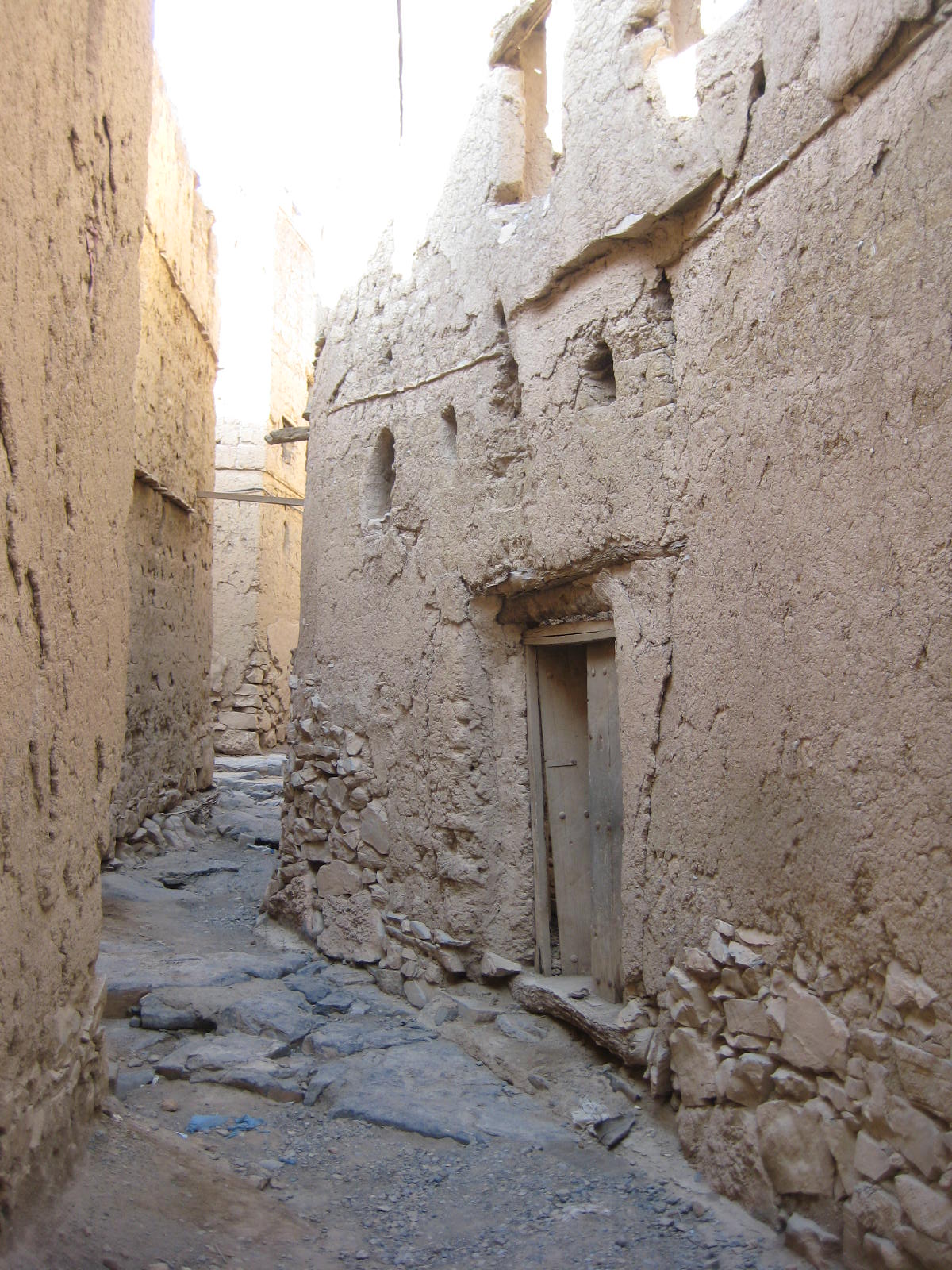
Al Hamra's mud brick houses are now largely deserted and the people have moved into new properties in the town.


Birkat Al-Mawz (The pool of bananas) has a great example of Oman's complex irrigation system, known as the falaj system. The channels were made to take water from underground springs to the fields but as you can see, they also make great swimming places.


We went dolphin watching but did not see any. However, Captain Khalid found us a great place to go snorkelling.

Monday, November 2, 2015

Salisbury Cathedral

The cathedral, its cloisters and extensive grounds are beautiful but sorry citizens of Salisbury, I was not impressed with your 'city' - lots of drunks making a noise in the market square.

The cathedral has tallest church spire in England (123m). Inside, the Magna Carta exhibition was very impressive and the cathedral guides were well informed and very helpful.
The oldest known working clock. There is no face so you cannot tell what time it is. It was designed to cause a bell to chime to indicate the time for each cathedral service.
The Salisbury font was designed by the renowned British water sculptor William Pye.  Cruciform in shape, the font has a 3-metre span to allow total immersion baptism.  


After Salisbury we took a trip to Shaftsbury to try to find a boy and a bike in a Hovis advert. He was long gone but Golden Hill is the place. It was wet and windy and so we could not enjoy a view of the beautiful valley. However, Golden Hill looked good in the mist.


Tuesday, October 13, 2015

Kilimanjaro Training Weekend


Libanus Youth Hostel, Brecon Beacons

Action Challenge provide well organised and very useful training weekends. I arrived at the Youth Hostel early Friday evening in time for dinner and a couple of the local Brecon beers. Group leaders Ian & Bron then gave us a detailed briefing on what to expect during the weekend and on 'Kili' as it came to be called - 'Kili' makes it sound nice and friendly at 19 000 feet! We had a tiny room for four blokes but fortunately for us, one did not turn up. However, due to very loud snoring I took my duvet down to the Common Room and had a very comfortable kip on  a long settee.

We are on the march at 0900hrs the next morning. March should not be the word, as Ian stresses the 'Alpine plod'. Nice & slow, never out of breath. The day before was sunny and warm but today there is thick cloud. You can see it coming up behind us as we climb Pen y Fan, the highest of the Brecon Beacons at 886m and we are in the cloud at the top.


After Pen y Fan we traverse to Corn Du and then down to Llyn Cwm Llwch (below) for lunch.

After lunch it is downhill virtually all the way back to the Hostel through the gorgeous Powys countryside. After a clean up, Ian provides us with a slide show about life on a 'Kili' climb, with a strong focus on acclimatisation and how to prepare for and deal with it. He then shows us all his gear. I got some Christmas present ideas!

Kipped in the Common Room again and after breakfast we walked the Cerrig crags - in thick cloud - down to the Storey Arms and back to the Llywyn y Celin hostel for lunch.
Twelve in the group and really good company.